In our recent information session featuring Mark Handy (Retired Navy Chief Petty Officer and Admissions Manager at the California Institute of Applied Technology, or CIAT) and the Military Friendly® leadership team, we revealed that one student demographic is not only surviving this environment but thriving: the military-connected student.
Military Friendly® schools have created a blueprint for success that institutions across the country should be scrambling to replicate.
The Performance Gap: Data That Demands Attention
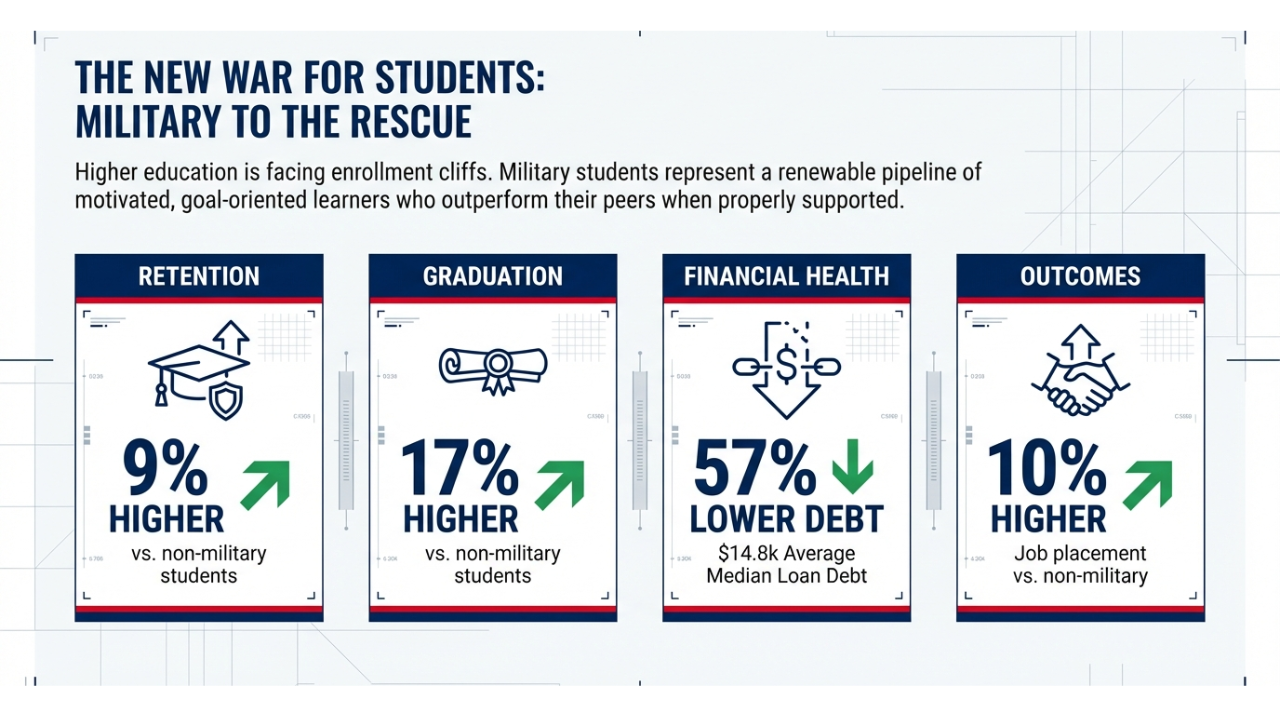
The webinar opened with a staggering statistical reality. When you compare military students at designated Military Friendly® schools against their civilian peers at the same institutions, the Veterans win in every category that matters to a Provost:
- 17% Higher Graduation Rate: Military students are finishing what they start at a rate that shatters that of their civilian peers at Military Friendly® Schools.
- 9% Higher Retention Rate: By fostering a sense of mission-based belonging, schools are keeping students enrolled through life’s biggest disruptions.
- 57% Lower Median Debt: With a median loan debt of just $14.8K, military students are graduating with a fraction of the financial burden carried by the average civilian student.
- 10% Higher Job Placement: Veterans aren’t just earning diplomas, but transitioning into the workforce at a higher rate than non-military students.
Pillar 1: Radical Academic Flexibility
Mark Handy emphasized that the traditional 16-week semester is often the greatest barrier to Veteran success. “Military life doesn’t happen in 4-month blocks,” Handy noted.
- Accelerated Sprints: 89% of top schools now offer 6-to-8-week courses. CIAT uses a 5-week model that allows students to focus intensely on one subject at a time, facilitating faster credit accumulation.
- The “Burnout Buffer”: One of the most innovative policies discussed was the mandatory one-week break between terms. Because Veterans often “run at 110%,” these scheduled pauses allow for mental “deflation,” which CIAT has identified as a critical factor in their high retention rates.
- Mapping Experience to Credit: 64% of top schools actively use the Joint Services Transcript (JST) to award credit for military service. This doesn’t just save time; it validates the student’s prior professional life.
Pillar 2: The Infrastructure of Empathy
You cannot serve Veterans with a “generalist” staff. The webinar highlighted that success is built on specialized staffing.
- Dedicated Teams: 75% of high-performing schools employ full-time certifying officials, while 62% have dedicated Military Program Managers.
- Admissions as Advocacy: Mark Handy described CIAT’s “Party of Three” model. Admissions advisors don’t just send links; they join screen-sharing sessions to help students navigate the labyrinth of VA.gov and ensure their Certificate of Eligibility (COE) is filed correctly.
- Language Matters: When a student hears an advisor use terms like MHA, BAH, and VR&E (Chapter 31) correctly, it builds immediate trust. It signals that the institution “speaks military.”
Pillar 3: Outcomes Over Outputs
The webinar concluded with a focus on the “Stackable Credential” model. In high-demand fields like IT and Cybersecurity, waiting four years for a degree is no longer necessary.
- Milestone-Based Learning: At CIAT, students are encouraged to earn industry-recognized certifications (CompTIA, Security+, etc.) within the first 20 weeks. This allows them to enter the workforce halfway through their degree program.
- The “Why” Methodology: Retention begins with a Personal Statement. By requiring students to articulate their career goals before enrollment, advisors have a north star to point to when the coursework gets difficult or life gets in the way.
The data from the 2025–2026 Military Friendly® survey makes one thing clear: a Military Friendly® designation is more than a marketing badge. It is a rigorous commitment to a workflow that prioritizes the Student-Veteran as a whole person. When institutions remove administrative red tape, map the Joint Services Transcript (JST) correctly to course credits, and provide dedicated social spaces, they don’t just help a Veteran; they secure the future of their institution.
Don’t wait to fall off the enrollment cliff. Check out the webinar replay, or book a discovery call with our team to match your institutional goals to our high-performance success metrics. Book Your Discovery Call at MilitaryFriendly.com/Discover